Fishing Harbour or Holiday Port: Two Screen Settings
Fishing harbour or holiday port scenes feel convincing when boats, buildings and daily activity point to a clear use, while leaving room for both.
The most common mistake in a fishing harbour or holiday port scene is treating the setting as a pretty background. A row of trawlers, ice-stained sheds or a polished marina can suggest a way of life, but only when the details agree. When they do not, viewers may not know why the scene feels false; they simply stop believing the harbour.
For filmmakers, location scouts and curious viewers, the useful question is not whether a port looks picturesque. It is what its boats, buildings and activity tell us about who belongs there, what the waterfront is for and how the place changes through the day. A working fishing harbour and a holiday port can share gulls, salt-streaked walls and bobbing vessels while telling very different stories.
Why does a harbour read as the wrong kind of place?
A setting becomes muddled when its strongest visual clues point in different directions. Imagine an invented scene: a family arrives at a sunlit marina to meet a fisher who works from a modern leisure yacht, while the quay has fish crates and a net-mending bench. None of these details is impossible on its own. Together, without an explanation, they leave viewers unsure whether this is a workplace, a resort or both.
Begin by deciding what the harbour does for the story. Is it where people earn a living, spend leisure time, move goods, meet visitors, or combine several functions? Then choose details that make the main use legible. A fishing port can accommodate visitors; a holiday marina can contain working craft. The aim is not to enforce a tidy division, but to show the relationship between those uses.
When reviewing a scene, look for the mismatch rather than immediately adding more nautical decoration. A few carefully chosen signs of use usually tell more than an indiscriminate spread of ropes, nets and anchors.
Do the boats tell the same story as the quay?
Boats are prominent clues because viewers can read their purpose from their shape, fittings and condition. Working fishing vessels may carry practical equipment, visible wear and gear associated with the kind of fishing the story depicts. Leisure boats more often foreground comfort, easy access and recreational fittings. These are tendencies, not rules: working craft can be immaculate, and a pleasure boat can look battered after a rough season.
The problem arises when a vessel's details look selected for appearance rather than use. A net on deck may signal fishing, but if the crew never handles it and the boat has no other signs of the work, it can feel like a prop. Conversely, a gleaming motor launch in a busy working basin needs a reason to be there. It might belong to a harbourmaster, a visiting customer or a local who keeps a recreational boat beside commercial craft; the scene can clarify that connection through a line of action or a small visual cue.
For a production, identify the boat's story function before choosing its look. Ask who uses it, what they do aboard and what condition the work leaves it in. For a viewer, notice whether people interact with the vessel in a way that fits its apparent purpose. A boat that is only framed, never handled, may be signalling less than the film intends.
Are the buildings working or merely picturesque?
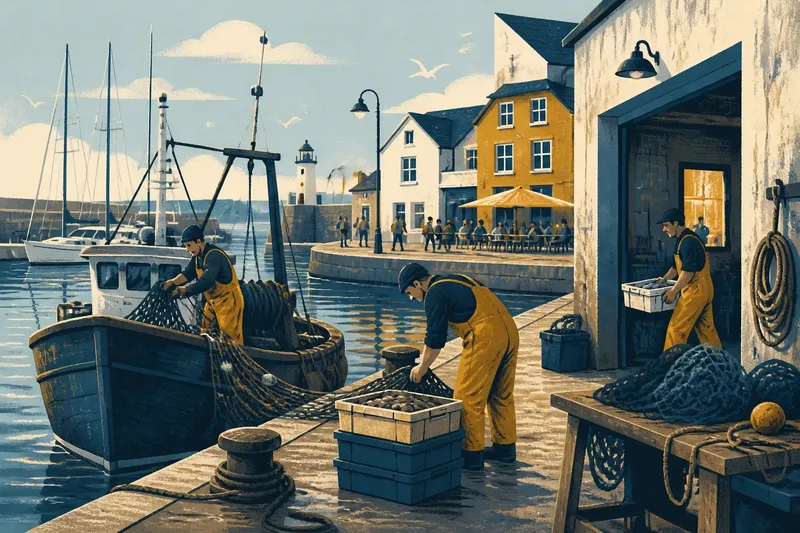
Harbour buildings also carry a social story. A fish market, net loft, boatyard, chandlery or ice store suggests work through its entrances, materials and relationship to the water. A promenade café, souvenir shop, hotel or public terrace suggests visitors and leisure. A mixed waterfront may contain both, but their placement matters: a service yard beside the quay feels different from a shopfront facing a visitor walkway.
One common source of confusion is using charming old façades as shorthand for a fishing community. A weathered wall does not tell us whether anyone still works behind it. Show the building doing something. A door opens for a delivery; a worker carries equipment through a yard; customers queue at a harbour-side café. Activity makes the architecture part of the story rather than a scenic label.
Pay attention to surfaces and maintenance, too. Salt, paint, repairs and clutter can indicate daily use, but they need a pattern. If every shed is equally distressed, the harbour may look artificially aged. If the working area is immaculate while a nearby visitor area is casually littered, the contrast may also feel contrived. Different buildings can be kept to different standards for understandable reasons; provide enough context for that difference to register.
Does the activity belong to the hour and season?
A harbour is not a static arrangement of boats. Its identity comes through routines: setting out, unloading, repairing, selling, walking, boarding and waiting. A scene that shows the right objects but the wrong activity can still feel unconvincing. A fishing quay full of idle people at a moment the story implies a busy landing needs an explanation. A holiday port with no visitors, staff or recreational movement may read as empty rather than peaceful.
Think about the scene's time of day and the work or leisure it contains. Fishing schedules vary by place, method and conditions; visitor activity shifts with weather, season and local custom. Avoid treating one imagined routine as universal. Instead, choose the specific action the scene needs and build the surrounding movement around it. A seller arranging catch, a crew checking equipment or a visitor stepping ashore can establish different rhythms without crowding the frame.
For a production, a brief harbour walk with local knowledge can reveal what is plausible to show and what needs adjustment. For a viewer, repeated background activity is a useful clue: does the film present the harbour as a workplace with visitors passing through, or as a leisure destination where work appears only at the edges?
Why do signs, clothes and props contradict the setting?
Small details can overturn a scene's larger impression. A fish box marked for a distant business, a leisure-hire sign beside a supposedly closed waterfront, or spotless clothing in a scene meant to show hands-on work may all raise questions. One discrepancy can be characterful; several unexamined ones can make the harbour feel assembled from generic coastal imagery.
Props and wardrobe need not be documentary-perfect, but they should have a reason. A character might keep clean clothes for customer-facing work, or a visiting tourist might wander into a working area in unsuitable shoes. Those choices can reveal personality or create a plot problem. The trouble is not that a person looks out of place; it is when the film seems unaware of the mismatch.
Check the details from the character's point of view. What would they carry, notice or avoid? Where would a visitor be welcome, and which door would a worker use? A sign or barrier can clarify access, while a brief exchange can show that two parts of the harbour operate under different expectations. Local rules, access and filming permissions vary, so productions should confirm them with the relevant harbour authority or property owner.
What should you check when a harbour scene feels muddled?
How can I tell a fishing harbour from a marina?
Look for a cluster of clues: vessel fittings, work gear, service buildings and what people do around them. A marina may still include working boats, so activity and layout matter as much as the craft.
Can a holiday port have working fishing boats?
Yes. A scene can show tourism and fishing sharing the waterfront, provided their relationship is clear. A landing area, visitor walkway or character interaction can show how people use the same place differently.
What makes a harbour scene look like a film set?
Details seem arranged for the camera but are not connected to any visible routine. Props without users, buildings without a purpose and background extras who never respond to harbour activity can create that effect.
How much harbour detail should a scene include?
Use enough to identify the place's main function and support the action, then let the rest remain ordinary. A few coherent details are often more persuasive than filling every corner with maritime equipment.
How can you make a mixed harbour identity clear?
Some of the most convincing screen ports are neither purely commercial nor purely recreational. Their character comes from overlap: a working quay beside a public path, a fishing boat among leisure craft, or a café serving both crews and visitors. The scene need not force every person into one category. It should let viewers see who uses which spaces, and when.
Say you are shaping an invented scene in which a young deckhand meets a friend after work. The starting point is a harbour with a fish landing area and a small public promenade. Place the meeting at the edge of the working zone. The friend waits behind a marked public boundary while the deckhand carries gear to a shed. The resulting image makes both the job and the visitor's position readable without explanatory dialogue; their shared setting becomes part of the relationship.
Clarity does not require a harbour to be spotless, quaint or neatly divided. It asks each visible detail to belong to someone and serve a purpose. When boats, buildings and activity agree about the harbour's life—even when they show competing uses—the setting can hold a story rather than merely frame it.
When you next watch a coastal film, follow one person across the quay: what can they touch, enter, buy or set out to do? That small route often reveals whether the harbour is a workplace, a destination or a complicated place where both lives meet.