When the Shoreline Becomes a Boundary in a Film
See how a shoreline boundary in film marks access, ownership and belonging, and learn to read gates, paths and public edges without mistaking scenery for story.
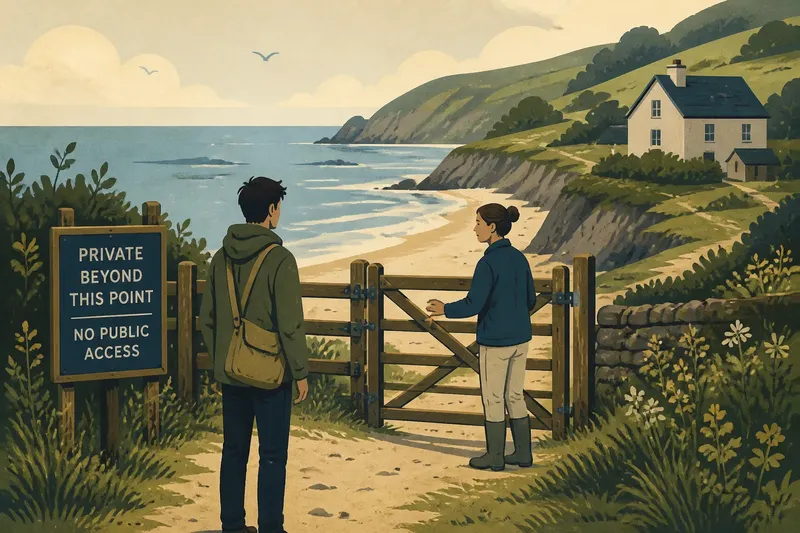
The common mistake in reading a shoreline boundary in film is to treat it as a line that simply divides land from sea. That misses the more revealing question: who is allowed to use the coast, and on what terms? A gate, a warning sign or a path that ends at a private entrance can turn a beautiful stretch of shore into a quiet dispute over access.
How does a shoreline boundary in film show who belongs?
Films can make belonging visible through access. A character may walk freely along a public path, then stop at a chain across a slipway. Someone else may pass through a gate without hesitation. The difference is not just about where they stand; it hints at whose presence is accepted, challenged or ignored.
Look for the boundary’s social signals. Is there a sign, a barrier or a person watching? Does a character ask permission, wait for an invitation or behave as though entry is already theirs? Even an unmarked route can feel restricted if the scene shows one person confidently using it while another hangs back.
What can gates, paths and signs tell us?
A gate can distinguish public passage from private property. A sign can make a rule explicit, while a worn path may suggest that people have been using a route despite the official boundary. These details do not settle the scene’s moral argument. They give it something concrete to turn on.
Pay attention to who handles the barrier. Opening a gate for someone can be an invitation, a routine courtesy or a display of control. Leaving it shut may be a refusal, but the scene needs to establish who has the right to open it. The same action can look welcoming or presumptuous depending on the relationships and rules already in view.
A useful distinction is between a boundary that restricts movement and one that marks status. A locked gate plainly limits access. An open gate may still carry social pressure if a character appears unsure whether they are welcome beyond it.
How do camera choices frame access and exclusion?
A wide shot can show a public path beside a private beach entrance, making the difference in access easy to read. A close shot of a hand hovering over a latch may instead focus attention on hesitation. Neither view supplies the whole meaning on its own. The scene’s sequence matters: what was shown before the character reached the barrier, and what becomes visible after?
Sound can make a boundary feel official or informal. A sign rattling in the wind is different from a guard calling after someone; waves may soften a conversation about permission without removing its consequence. Editing also matters. A cut that shows one person entering and another left outside can make exclusion plain without explaining the rules aloud.
How should you read access, ownership and belonging?
Does a fence always mean a character is unwelcome?
No. It may mark a practical limit, a safety measure or private property without making a claim about the character personally. Look for how other people respond to the fence and whether the film shows anyone being permitted through.
What does a character’s hesitation at a gate suggest?
Hesitation can indicate uncertainty about permission, fear of being seen or reluctance to cross a social line. The scene’s dialogue, glances and earlier access choices help distinguish these readings.
Can a public shore still feel exclusive?
Yes. A public route may be difficult to find or may run beside an entrance that signals wealth and privilege. The film can contrast the right to pass with the confidence to linger, making unequal comfort visible without changing the official boundary.
What if the film never explains who owns the shore?
Track the actions rather than guessing at local law. Note who uses each route, who challenges them and whether the film treats that challenge as fair, routine or threatening.
How can you map a boundary scene without overreading it?
Imagine a fictional scene in which a visitor approaches a coastal footpath ending at a closed wooden gate. They read a sign stating that the path beyond is private, then turn to a nearby resident, who opens the gate and invites them through. The observable result is a shift from exclusion to permission: the sign establishes a limit, and the resident’s action changes who may cross. It would be a stretch to infer a deeper conflict unless the film gives another clue.
For your own reading, note the visible boundary, the person who controls or observes it, and the response it produces. Then ask what changes when someone approaches: do they pass, wait, ask, or turn away? A shoreline boundary in film often reveals its meaning through that small exchange, where access becomes a question of belonging rather than scenery.