From Painted Sea to Location Shore: How Coastal Film Backdrops Changed
Coastal film backdrops shape what a shoreline can express. Learn how studio scenery, rear projection and location filming create distinct screen images.
The common mistake with coastal film backdrops is to assume a real shore always makes a scene more truthful. That can obscure what a constructed view contributes: a painted horizon can hold a precise mood, while a location brings the shifting light and uneven contours of a particular place. The history is not a straight march from painted sea to location shore; filmmakers have kept choosing among these methods and combining them.
Early studio craft, later projection techniques and location work each changed what a coastal scene could show. Their differences are easiest to see in the way they handle depth, motion and the space around performers.
What could a painted sea control?
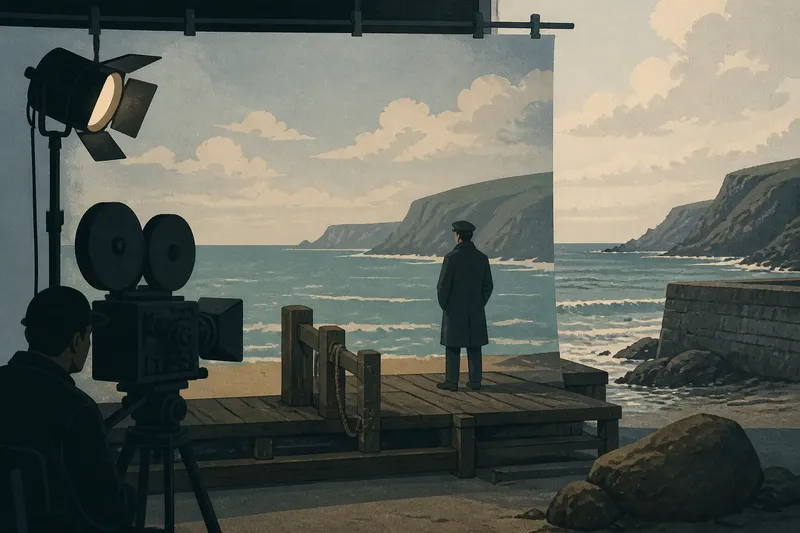
A painted backdrop let a studio suggest a distant coast without sending a crew to one. The artist could place a horizon or cliff line where the camera needed it, while constructed rocks and a stage floor supplied the foreground. The result depended on the camera’s viewpoint: from the intended angle, separately made elements could read as one setting.
That description applies to a broad studio practice, not every film or period. The actual design might be a flat painted drop, a more elaborate stage arrangement, or a combination of scenic pieces. Without identifying a particular production, it is safer to describe what these methods made possible than to claim that a specific film used them.
Painting also changed the image’s character. A simplified sea could keep the eye on a performer or make the horizon feel composed rather than observed. Look at the edge where a painted distance meets a physical foreground: the join, if visible, tells you about the image’s construction, not necessarily about a failure of craft.
How did rear projection add movement?
Rear projection showed a previously filmed image on a screen behind performers, with the camera recording both the projected view and the foreground action. For a coastal scene, that background could contain moving water or a passing shoreline while the performers worked on a controlled set.
The method joined two kinds of motion, but they did not always feel equally present. The projected sea had already been photographed; the performers and foreground were being filmed in the current setup. Differences in focus, brightness or movement can make that separation legible, though those clues alone cannot establish which technique a production used.
When watching, compare the background’s texture and light with the faces, railings or cabin around it. Treat any mismatch as a visual clue, not a verdict. A scene may use the effect to make the coast feel like a view being watched rather than a space the characters can enter.
What did location filming change?
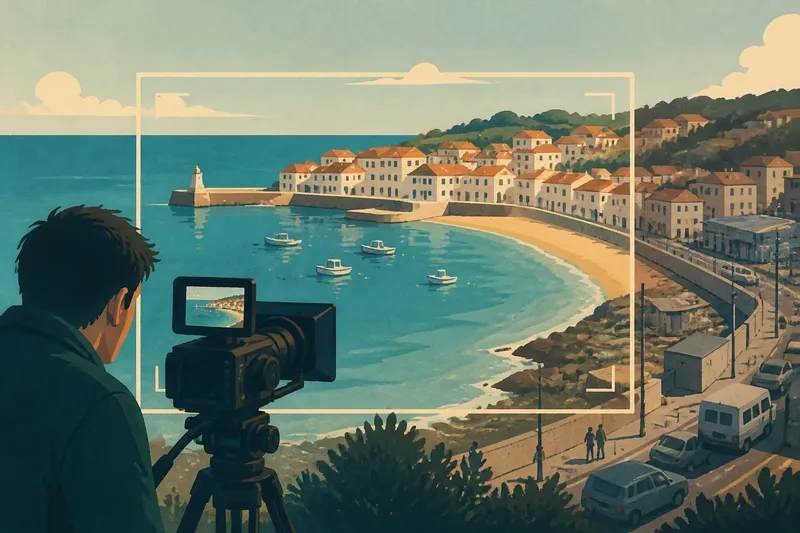
Filming on a real shore put the camera among existing terrain. A headland, beach or harbour wall could lend the frame specific shapes and changing conditions that a studio had to create by other means. Cloud, reflections and wind could alter the image during filming, so the location offered variation as well as practical uncertainty.
It did not remove design. The crew still selected a viewpoint, framed the horizon and decided what fell outside the image. A wide composition might set a person against open water; a closer frame could use a wall or boat to confine the visible space. The camera turns a place into a particular view, whether the coast is real or built.
It is also better to avoid treating location work as a single historical turning point. Studio scenery, projection and location filming have coexisted in screen production; the balance varies by film and scene. Unless a production’s records or credits establish its methods, the image itself supports careful observation, not a definitive account of how it was made.
Why do films combine built and real shores?
A coastal sequence can draw on more than one kind of setting. A real shoreline may provide an expansive view, while a constructed landing stage or interior gives performers a controlled place to move. Such combinations are a craft option, not a claim that every apparent coast was assembled this way.
Imagine a fictional scene in which a character waits for a boat on a grey shore. The director chooses location footage for the shifting horizon, then uses a constructed landing stage for the foreground so the performer can stand in a precise silhouette. The resulting image has irregular movement in the distance and a deliberate outline nearby; it does not need to disguise the fact that its parts were made separately.
When considering a particular film, distinguish what you can see from what you can infer. You can describe a sharp foreground against a softer distance; you cannot identify the exact production method from that contrast alone.
What should you look for in coastal film backdrops?
- Compare the light: Observe whether the background and foreground seem lit from the same direction. If they align, treat the view as visually coherent; if they differ, consider separate image layers but do not call that proof.
- Follow the horizon: Observe whether it stays steady in relation to the foreground as the camera moves. If it shifts naturally with the view, read the space as connected; if it seems fixed or detached, consider projection or compositing as possibilities.
- Check the edges: Observe where a figure, railing or rock meets the water. If the textures blend, note a continuous-looking image; if they differ, consider a constructed join and keep the production claim tentative.
- Notice repeated patterns: Observe whether waves, rocks or distant structures look unusually regular. If they do, consider deliberate design or repetition; if they do not, do not assume the scene must be location footage.
- Compare movement: Observe whether performers and the sea seem to respond within the same space. If their movement feels connected, describe that effect; if it feels separate, consider a projected or layered background without treating it as certain.
- Ask what the framing emphasises: Observe whether the image gives more space to open water or to walls, boats and foreground objects. If the sea dominates, describe an expansive composition; if built forms dominate, describe a more enclosed one.
These checks help explain how a shot works, even when its production history remains unknown. The image can be analysed on its own terms without turning visual clues into unsupported claims about a film’s process.
Which questions help distinguish coastal backdrops?
Does a painted sea always look artificial?
It may look deliberately stylised, but the effect depends on the artwork, lighting and framing. A simplified horizon can direct attention or suit a scene built around a composed view.
Can location filming make a shore feel unreal?
Yes. A real coast can appear remote or dreamlike through its viewpoint, light and framing. The location supplies the terrain; the finished shot gives it a particular screen character.
Why put performers on a set beside coastal footage?
A set can provide a controlled foreground, while filmed scenery supplies movement or a wider view. The two can be combined to give a shot distinct qualities at different depths.
Can you identify a technique from the image alone?
Usually, visual clues support possibilities rather than certainty. Production records, credits or reliable documentation are needed to make a firm claim about how a particular shot was made.
How did coastal backdrops expand screen choices?
Painted scenery offered control over the view; rear projection could place recorded movement behind performers; location filming brought existing terrain into the frame. These methods did not simply replace one another. Their continued use gave filmmakers different ways to shape depth, motion and the relation between a character and the visible shore.
On a rewatch, follow one line from the performer to the horizon. Note where the image feels continuous, where it separates into layers and what the framing keeps outside view. That close observation makes the craft of the coastal backdrop visible without mistaking a visual impression for a documented production history.